
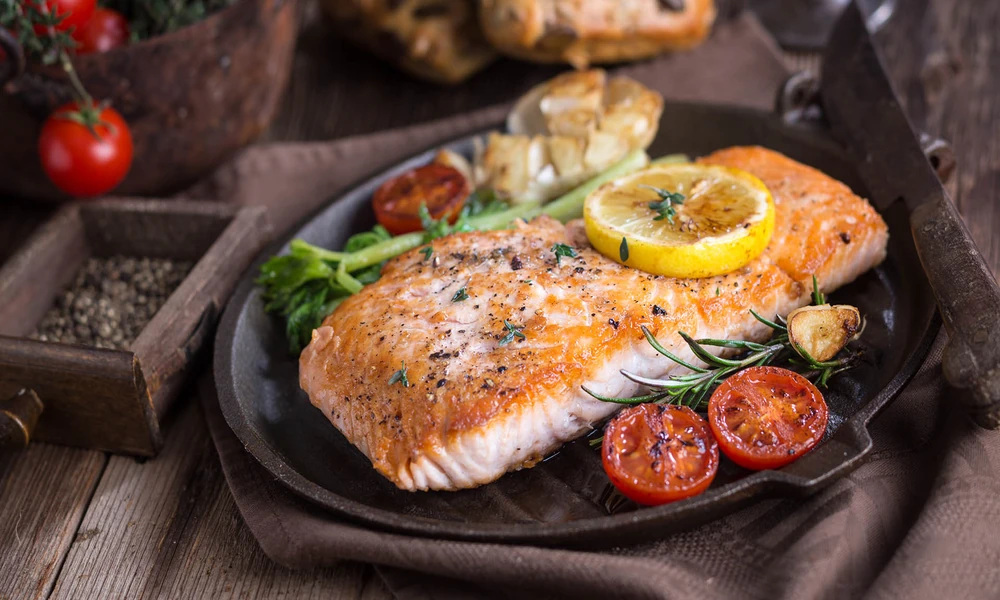
Few ingredients carry as much cultural weight – or as much ecological complexity – as wild Pacific salmon. It has sustained Indigenous communities along the Northwest Coast for thousands of years, shaped the commercial fishing economy of Alaska and British Columbia, and become one of the most recognizable symbols of a region defined by cold water, dense forest, and the rhythms of the natural world. It also happens to be among the finest eating fish in the world when it’s fresh and handled well.
The Five Species Worth Knowing
Pacific salmon isn’t a single fish. Five species run in North American waters, each with a distinct flavor profile, fat content, and season.
Chinook – also called king salmon – is the largest and most prized. Its high fat content produces a rich, buttery texture and a flavor that needs very little embellishment. It’s the salmon most likely to appear on fine dining menus and the one most likely to be the memorable fish of a trip to Alaska.
Sockeye is leaner than Chinook with a deeper red flesh and a more pronounced, distinctly salmon flavor. It holds up well to bold preparations – smoke, strong seasoning, high heat – and is one of the most popular species for home cooking because its flavor is assertive enough to carry a dish.
Coho sits between Chinook and sockeye in fat content. It has a milder, more delicate flavor that rewards gentler cooking methods. Fresh coho in season is outstanding; it’s also the species most likely to appear in sport fishing catches along the Inside Passage.
Pink and chum are the most abundant and most commercially harvested species. Fresh pink salmon in season is underrated – mild and delicate – though it’s most commonly processed and canned. Chum, similarly, is often overlooked in fresh form despite being a solid eating fish when properly handled.
Travelers on an Alaskan cruise encounter salmon not just on menus but as part of the ecology of every port they visit. The rivers running through Ketchikan, the hatcheries in Juneau, the bears fishing the streams near the glacier – salmon is the thread connecting the landscape, the wildlife, and the food in a way that’s hard to fully appreciate until you’re there.
The Sustainability Question
Wild Pacific salmon from Alaska is among the most sustainably managed seafood in the world. Alaska’s salmon fisheries are governed by the Alaska Department of Fish and Game under a constitutional mandate to manage fisheries on a sustained yield basis – meaning harvests are set based on escapement goals that ensure enough fish return to spawn each year to maintain the population.
The Marine Stewardship Council certifies Alaska’s major salmon fisheries as sustainable, and the management system has a track record of maintaining healthy wild populations over decades. For consumers navigating the often confusing sustainability claims in the seafood market, wild Alaskan salmon is one of the cleaner choices available.
Atlantic salmon labeled as wild is a different matter – Atlantic salmon populations are severely depleted, and virtually all Atlantic salmon sold commercially is farmed. Farmed salmon varies considerably in quality and sustainability depending on the production system. When the label matters to you, asking specifically about wild versus farmed and the species and origin gives you the information you need.
How to Source It at Home
The best wild Alaskan salmon reaches the lower 48 in two forms: fresh during the relatively short season and frozen the rest of the year. Properly frozen wild salmon – vacuum-sealed and flash-frozen at sea – is genuinely excellent and preferable to “fresh” fish that has been sitting in transit for days. The tell for quality frozen fish is that it should show no signs of freezer burn, the flesh should be firm and bright when thawed, and it should smell clean and oceanic rather than fishy.
Seafood-focused fishmongers, better grocery stores, and community-supported fishery programs that ship directly from Alaskan fishing operations are all reliable sources. The CSF model in particular tends to deliver exceptional quality because the fish is handled by people whose livelihood depends on its reputation.
Cooking It Well
The central mistake in cooking salmon is overcooking it. Wild salmon is leaner than farmed, which means it dries out faster and more completely. The target internal temperature is around 125°F for a silky, just-set texture – noticeably lower than the 145°F that food safety guidelines specify, which produces dry, chalky fish.
For a skin-on fillet, starting it skin-side down in a cold pan with a small amount of oil and bringing the heat up gradually renders the skin crispy without the flesh overcooking. The fish is done when it’s just beginning to turn opaque in the thickest part and still slightly translucent at the center.
Simplicity rewards the fish. Good olive oil or butter, salt, lemon, and perhaps a fresh herb are all that’s needed for a piece of wild Chinook or sockeye to be excellent. Bold preparations – a miso glaze, a cedar plank, a cure of salt and dill – work well with sockeye’s assertive flavor and less well with the more delicate species.
The one thing to avoid is treating it like farmed salmon, which has enough fat to survive aggressive heat. Wild Pacific salmon is a better fish and a more demanding one. Treat it accordingly.
